Ekadhasi
Talk to Astrologer Order Report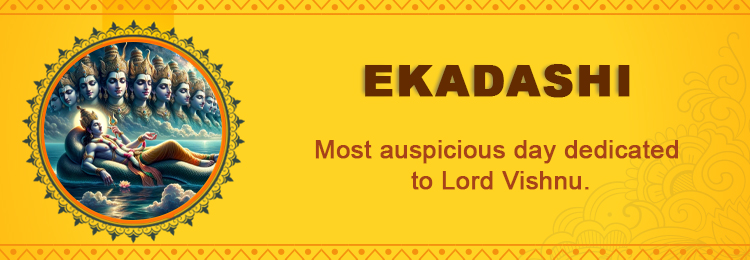
Upcoming Dates
Ekadashi: The Sacred Day of Lord Vishnu
Ekadashi is a Hindu sacred observance on the eleventh day of every lunar fortnight. The word Ekadashi means 'eleven' in Sanskrit and refers to the eleventh lunar day (Tithi) of each of the two phases of the moon - the bright half (Shukla Paksha) and the dark half (Krishna Paksha). There are 24 Ekadashi observances in a year, each with a different name and significance. Ekadashi is dedicated to Lord Vishnu, the supreme deity of Hinduism, also known as Hari, Narayana, and Vasudeva. Devotees of Lord Vishnu observe a strict fast on Ekadashi and offer prayers, chants, and hymns to him. It is believed that by observing Ekadashi, one can attain liberation (Moksha) from the cycle of birth and death and reach Vaikuntha, the abode of Lord Vishnu.
Significance of Ekadashi
Ekadashi is considered one of the most auspicious and important days in Hinduism. According to the scriptures, Ekadashi is the day when Lord Vishnu sleeps on the cosmic ocean of milk (Kshirasagara) on his serpent couch (Shesha Naga) and awakens after four months on Prabodhini Ekadashi. During this period, known as Chaturmasa, Lord Vishnu is in a state of deep meditation and grants his devotees the opportunity to worship him and seek his blessings. Ekadashi is also when Lord Vishnu fought with the demon Mura and defeated him with his Sudarshana Chakra. Lord Vishnu created a female energy named Ekadashi from his body to commemorate this victory. He entrusted her with protecting his devotees from the influence of evil forces. Therefore, one can invoke the protection and grace of Lord Vishnu and Ekadashi Devi by observing Ekadashi.
Legends of Ekadashi
There are many legends associated with Ekadashi in Hindu mythology. One of them is the story of King Ambarisha, who was a great devotee of Lord Vishnu. He observed Ekadashi's fasts with utmost devotion and followed all the rules and rituals. Once, he was performing a special Ekadashi fast called Dwadashi Parana, which requires breaking the fast at a specific time the next day. However, he faced a dilemma when Sage Durvasa arrived at his palace as a guest and asked him to wait until he finished his bath and prayers before breaking his fast. King Ambarisha knew that if he waited for the sage, he would miss the auspicious time for breaking his fast, and if Ambarisha broke his fast without serving the sage, he would incur his wrath. He decided to break his fast by drinking water, which is considered equivalent to eating and not eating food. When Sage Durvasa returned, he was furious that King Ambarisha had broken his fast without him and cursed him with his fiery glance. However, Lord Vishnu intervened and protected King Ambarisha with his Sudarshana Chakra, which chased Sage Durvasa all over the universe until he begged for forgiveness from King Ambarisha. This legend shows that Lord Vishnu is pleased with those who observe Ekadashi sincerely and save them from harm.
Another legend is the story of King Rukmangada, a devout follower of Lord Vishnu. He observed all the Ekadashi fasts with his family and subjects. Once, he met a beautiful princess named Shobhana in the forest and fell in love with her. He married her and brought her to his palace. However, Shobhana was unaware of the Ekadashi fasts and refused to observe them. She also tried to persuade King Rukmangada to give up his fasts and enjoy worldly pleasures with her. King Rukmangada was torn between his love for his wife and his devotion to Lord Vishnu. He tried to explain the importance of Ekadashi, but she did not listen. She even threatened to kill herself if he did not break his fast on Ekadashi. King Rukmangada was shocked by her behavior and decided to leave her and go to the forest to worship Lord Vishnu. However, Lord Vishnu appeared before him and praised him for his steadfastness. He also revealed that Shobhana was an incarnation of Lakshmi, his consort, who had come to test his faith. He blessed King Rukmangada with eternal bliss and reunited him with Shobhana, who also became a devotee of Lord Vishnu. This legend shows that Lord Vishnu rewards those who observe Ekadashi faithfully and grants them his love and companionship.
Important festivals associated with Ekadashi
Many festivals are celebrated on Ekadashi days throughout the year. Some of the most important ones are:
- Vaikuntha Ekadashi: This is the most auspicious Ekadashi of the year, which falls in Margashirsha (December-January). It is believed that on this day, the gates of Vaikuntha, the heavenly abode of Lord Vishnu, are opened for his devotees, and they can attain salvation by worshipping him. Devotees observe a strict fast and stay awake all night chanting the names of Lord Vishnu. They also visit temples and offer him flowers, fruits, and sweets. Vaikuntha Ekadashi is also known as Mukkoti Ekadashi or Swarga Vathil Ekadashi.
- Nirjala Ekadashi: This is the most difficult Ekadashi of the year, which falls in Jyeshtha (May-June). It is also known as Pandava Nirjala Ekadashi or Bhima Ekadashi. It is named after Bhima, the second Pandava brother, who could not observe all the Ekadashi fasts due to his voracious appetite. He sought the advice of Sage Vyasa, who told him to keep a single fast on Nirjala Ekadashi without consuming even water or any other liquid. By doing so, he would benefit from observing all the Ekadashi fasts in a year. Devotees observing Nirjala Ekadashi follow the same rule and abstain from food or drink for 24 hours. They also perform charity and service to others on this day.
- Devshayani Ekadashi: This is the day when Lord Vishnu goes to sleep on his serpent couch in the cosmic ocean for four months. It falls in the month of Ashadha (June-July) and marks the beginning of Chaturmasa, the holy period of four months. Devotees observe a fast and offer prayers to Lord Vishnu before he goes to sleep. During this period, they also refrain from any auspicious activities, such as marriages, house-warming ceremonies, etc. Devshayani Ekadashi is also known as Ashadhi Ekadashi or Hari Shayani Ekadashi.
- Prabodhini Ekadashi: This is the day Lord Vishnu wakes up from his four-month-long sleep and blesses his devotees with grace. It falls in Kartika (October-November) and marks the end of Chaturmasa, the holy period of four months. Devotees observe a fast and pray to Lord Vishnu after he wakes up. During this period, they also resume their auspicious activities, such as marriages, house-warming ceremonies, etc. Prabodhini Ekadashi is also known as Kartiki Ekadashi or Utthana Ekadashi.
Benefits of observing Ekadashi
Observing Ekadashi has many benefits for the body, mind, and soul. Some of them are:
- Ekadashi Fasting helps detoxify the body and improve digestion, metabolism, and immunity.
- It also helps reduce weight, blood pressure, cholesterol, and blood sugar levels.
- Ekadashi Fasting enhances mental clarity, concentration, memory, and creativity.
- It increases spiritual awareness, devotion, and faith.
- Ekadashi Fasting removes sins, obstacles, and troubles from life.
- It bestows peace, happiness, prosperity, and success in life.
- Ekadashi Fasting leads to liberation from the cycle of birth and death and the attainment of Vaikuntha.
Astrological Significance of Ekadashi
Ekadashi has a significant impact on the astrological aspects of life. According to astrology, each lunar day (Tithi) has a ruling planet (Graha) that influences its effects. The eleventh lunar day (Ekadashi) is ruled by Saturn (Shani), considered the most powerful and malefic planet in astrology. Saturn represents discipline, karma, justice, delay, hardship, and detachment. Observing a fast on Ekadashi can appease Saturn and reduce its adverse effects on life. One can also overcome the problems caused by Sade Sati (seven-and-a-half years of Saturn's transit over one's moon sign), Dhaiya (two-and-a-half years of Saturn's transit over one's fourth or eighth house), or Shani Dasha (Saturn's major period).
Moreover, by worshipping Lord Vishnu on Ekadashi, one can invoke his blessings and protection from the adverse effects of Saturn. Lord Vishnu is the preserver and protector of the universe, and he is also the lord of the ninth house (Bhagya Sthana) in astrology, representing fortune, luck, and spirituality. By observing Ekadashi, one can enhance one's ninth house and attract positive outcomes in life.
Contact Sulekha
If you want to know more about Ekadashi and its astrological significance, you can contact Sulekha, India's leading online platform for local services. Sulekha connects you with verified and experienced astrologers who can provide personalized guidance and solutions for your problems. You can also get online horoscope, kundali matching, numerology, Vastu, tarot, and other services from Sulekha. To contact Sulekha, you can visit our website or call us. You can also download their app from the Google Play Store or Apple App Store and access our services instantly.
Sulekha is your one-stop destination for all your astrological needs. Contact Sulekha today and get the best advice from the experts.