Amavasai
Talk to Astrologer Order Report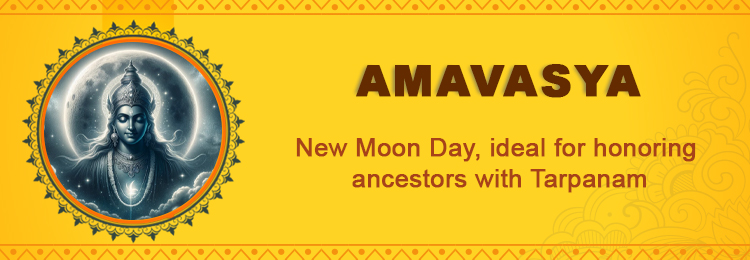
Upcoming Dates
Amavasya
Amavasya is when the moon is not visible in the sky and the lunar month ends. It occurs once every month, usually in the middle of the English calendar month. Amavasya is also known as No Moon Day or New Moon Day. Different types of Amavasya have different names, such as Darsha Amavasya, Mauni Amavasya, Mahalaya Amavasya, etc.
Significance of Amavasya:
Amavasya is a significant day in Hindu religion and culture, as it has a lot of spiritual and astrological significance. It is believed that Amavasya is a day of darkness when negative energies and evil forces are more powerful. Therefore, it is a day of fasting, praying, and performing rituals to ward off evil and seek blessings from the divine. Some common rituals on Amavasya are tarpanam, shradh, pitru puja, etc., which are done to pay homage to the ancestors and appease their souls. Amavasya is a day of new beginnings when one can start a venture or activity with positive intentions and auspiciousness.
Legends of Amavasya:
- One legend is that Amavasya is associated with Chandra, the moon God in Hindu tradition, and Daksha Prajapati. Legend states that Daksha Prajapati had 27 daughters, the Nakshatras or birth stars in Hindu astrology. Among the 27 wives, Chandra loved Rohini the most, causing jealousy among other wives who complained to Daksha Prajapati. Daksha then cursed Chandra to lose his brightness and die. Chandra then sought the help of Lord Shiva, who agreed to save him by placing him on his head. However, the curse could not be revoked entirely, so Chandra had to go through a cycle of waxing and waning, where he would grow full and bright and then gradually fade away to nothing. Amavasya is the day when Chandra becomes invisible due to the curse.
- Another legend is that Amavasya is when Lord Vishnu took the form of a dwarf Brahmin, known as Vamana, and visited King Bali, who was a generous and righteous ruler and a threat to the gods. Vamana asked Bali for a piece of land he could cover in three steps as a donation. Bali agreed but soon realized that Vamana was no ordinary Brahmin but an incarnation of Vishnu. Vamana then grew in size, covered the earth and sky in two steps, and asked Bali where he should place his third step. Bali offered his head as the third step, and Vamana pushed him to the underworld. However, Vishnu was pleased with Bali's devotion and granted him a boon to visit his kingdom and subjects once a year. This day is known as Bali Pratipada or Bali Padyami, celebrated on the first day of Kartik month, the day after Diwali Amavasya.
- A third legend is that on an Amavasya day, Lord Rama killed Ravana, the demon king of Lanka, who had abducted Rama's wife, Sita. Rama fought a fierce battle with Ravana for ten days, finally defeating him on the 10th day of Ashwin month, also known as Vijaya Dashami or Dussehra. Rama returned to his kingdom Ayodhya with Sita and his brother Lakshmana after 14 years of exile. The people of Ayodhya welcomed them by lighting lamps and candles all over the city. This day is celebrated as Diwali Amavasya or Deepavali Amavasya.
Important Festivals associated with Amavasya:
Amavasya is also associated with various festivals celebrated with great zeal and enthusiasm. Some of the major festivals that are celebrated on Amavasya are:
- Diwali: Diwali is the festival of lights that marks the victory of good over evil and light over darkness. It is celebrated on the Amavasya of Kartik month, also known as Diwali Amavasya or Deepavali Amavasya. It is believed that on this day, Lord Rama returned to his kingdom, Ayodhya, with his wife Sita and his brother Lakshmana after defeating Ravana, the demon king of Lanka. The people of Ayodhya welcomed them by lighting lamps and candles all over the city. On this day, people decorate their homes with lights and rangoli, exchange gifts and sweets, worship Goddess Lakshmi and Lord Ganesha, and burst crackers.
- Kali Puja: Kali Puja is the festival of worshipping Goddess Kali, the fierce form of Goddess Durga. It is celebrated on the same day as Diwali in some parts of India, especially in West Bengal, Odisha, Assam, and Bihar. It is believed that on this day, Goddess Kali killed the demons Shumbha and Nishumbha, who were terrorizing the world. On this day, people offer animal sacrifices to Goddess Kali, perform puja and aarti, and chant mantras and hymns.
- Somvati Amavasya: Somvati Amavasya is the Amavasya that falls on a Monday. It is considered to be very auspicious and beneficial for women. It is believed that fasting and worshipping Lord Shiva and Goddess Parvati on this day can grant long life and happiness to one's husband. It can also fulfill one's wishes and desires. On this day, women bathe in a holy river or lake, offer water to a peepal tree, tie a thread around it, and circumambulate it seven times. They also listen to or recite the story of Somvati Amavasya.
- Shani Jayanti: Shani Jayanti is the birthday of Lord Shani, the son of Lord Surya (Sun) and Goddess Chhaya (Shadow). It is celebrated on the Amavasya of Jyeshtha month, also known as Shani Amavasya or Vat Savitri Amavasya. It is believed that worshipping Lord Shani on this day can remove the ill effects of Shani Dasha or Shani Sade Sati in one's horoscope. It can also bring good luck and prosperity. On this day, people offer oil, black sesame seeds, black cloth, iron nails, etc., to Lord Shani, chant Shani Mantra or Shani Chalisa, and donate food and clothes to the poor.
Astrological Significance of Amavasya
According to Hindu astrology, the moon is one of the nine planets (navagrahas) that influence the karma and destiny of a person. The moon also represents a person's mind, emotions, intuition, creativity, and fertility.
The moon goes through different phases in its monthly cycle, such as the new moon (Amavasya), full moon (pournami), and crescent moon (Shukla and Krishna paksha). Each phase has a different effect on the moon's energy and influence on a person's life. The moon also transits through different constellations (nakshatras) and signs (rashis) in its monthly cycle, affecting the moon's energy and influence on a person's life.
Amavasya is the new moon day when the moon is not visible in the sky. It is considered a time of darkness, ignorance, and negativity. It is also a time of endings, transitions, and transformations. Amavasya can affect a person's mental and emotional state and result in fear, anxiety, depression, or anger. Amavasya can also bring out the hidden or suppressed aspects of a person's personality, such as secrets, lies, or sins.
The astrological significance of Amavasya may vary depending on the nakshatra and rashi of the moon on that day, as well as the nakshatra and rashi of a person's birth chart. Therefore, it is advisable to consult an expert astrologer to learn more about the rituals and remedies one should follow to get the maximum benefits of this sacred observance.
Contact Sulekha
If you want to know more about how Amavasya affects your life and destiny according to your birth chart and planetary positions, you can consult an astrologer online or over the phone through Sulekha Astro Services. Sulekha Astro Services connects you with verified and experienced astrologers who can offer personalized and accurate readings based on various astrology services.
Sulekha Astro Services helps you find the best astrologers in the USA, Canada, and India who can provide reliable and insightful advice on various aspects of your life. You can choose from different types of astrology, such as Vedic, Western, Chinese, or Tarot. You can also read reviews and ratings from previous customers to help you make an informed decision. To book an appointment with an astrologer, visit the Sulekha Astro Services website today and get the guidance you need.