Chathurthi
Talk to Astrologer Order Report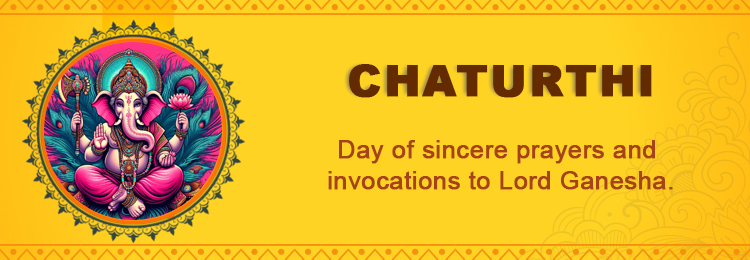
Upcoming Dates
Chaturthi: A Sacred Observance in Hinduism
Chaturthi is the fourth day of a lunar fortnight in the Hindu calendar. It comes twice a month, once in the waxing phase (Shukla Paksha) and once in the moon's waning phase (Krishna Paksha). Chaturthi is considered a sacred observance in Hinduism, associated with various deities, legends, festivals, and benefits.
Significance of Chaturthi
Chaturthi means "the fourth" or "the one beyond three." It implies that this day transcends the three states of consciousness: waking (jagruti), dreaming (Swapna), and deep sleep (sushupti). It represents the fourth state of consciousness, called turiya or samadhi, of pure awareness and bliss. Reaching Chaturthi is the very goal of a seeker who wants to attain liberation from the cycle of birth and death.
Chaturthi is also significant because it relates to the universe's creation and dissolution. According to some scriptures, the universe was created on the fourth day of Brahma's life, corresponding to Chaturthi. Similarly, the universe will be dissolved on the fourth day of Brahma's death, corresponding to Chaturthi. Therefore, Chaturthi symbolizes both the beginning and the end of creation.
Legends of Chaturthi
Chaturthi is associated with various legends and stories in Hindu mythology. Some of them are:
- The birth of Ganesha: Ganesha, the elephant-headed god of wisdom and success, is said to have been born on Chaturthi of Shukla Paksha of Bhadrapada month (August-September). His mother, Goddess Parvati, created him from the dirt of her body and asked him to guard the door while she bathed. When her husband, Lord Shiva, returned from meditation and tried to enter the house, Ganesha stopped him as he did not recognize him. Shiva became angry and cut off Ganesha's head with his trident. Parvati was devastated and demanded that Shiva restore her son's life. Shiva then replaced Ganesha's head with that of an elephant and revived him. He also declared that Ganesha would be worshipped before any other god on Chaturthi.
- The curse of Durvasa: Durvasa was a sage known for his short temper and curses. Once, he visited Indra, the king of gods, and offered him a garland of flowers that he had received from Lord Vishnu. Indra accepted the garland but casually threw it on his elephant Airavata, who trampled it. Durvasa felt insulted and cursed Indra and all the gods to lose their power and glory. As a result, the demons attacked the heaven and defeated the gods. The gods then sought the help of Lord Vishnu, who advised them to churn the ocean of milk to obtain the nectar of immortality. However, the churning produced many other things, including poison, gems, herbs, and celestial beings. Among them was Surya, the sun god, who emerged on Chaturthi of Krishna Paksha of Margashira month (November-December). He was so bright and hot that he scorched everything around him. The gods then requested him to reduce his intensity and radiance, which he agreed to do on all days except Chaturthi.
- The death of Krishna: Krishna was an avatar or incarnation of Lord Vishnu who came to earth to establish dharma or righteousness. He performed many miracles and deeds and played a vital role in the Kurukshetra war between the Pandavas and the Kauravas. He also taught the Bhagavad Gita to Arjuna on the battlefield. After completing his mission on earth, Krishna left his mortal body and returned to his abode. He was killed by a hunter's arrow on Chaturthi of Krishna Paksha of Bhadrapada month (August-September), which was also an eclipse day. The hunter mistook his foot for a deer's ear and shot him. Krishna forgave the hunter and ascended to his abode, but his death marked the end of the Dwapara Yuga and the beginning of the Kali Yuga, the age of darkness and evil.
Important Festivals Associated with Chaturthi
Despite being considered unfavorable days, Chaturthi days are also associated with some important festivals and observances in Hinduism. Some of them are:
- Ganesh Chaturthi: This is a festival dedicated to Lord Ganesha, the son of Lord Shiva and Goddess Parvati. It falls on Chaturthi of Shukla Paksha of Bhadrapada month (August-September), usually a Karinaal day. On this day, devotees worship Ganesha with fervor and devotion and offer him various offerings such as modak, laddu, coconut, etc. They also install clay idols of Ganesha in their homes or public places and immerse them in water after 10 days. The festival celebrates Ganesha as the god of new beginnings, the remover of obstacles, and the giver of wisdom and success.
- Sankashti Chaturthi: This observance is performed on the Chaturthi of Krishna Paksha every month, also a Karinaal day. On this day, devotees fast and pray to Ganesha to remove their difficulties and fulfill their wishes. They conclude the fast at night after seeing the moon, preceded by prayers to Ganesha. They also recite the Ganapati Atharvashirsha, a hymn that praises Ganesha's attributes and powers. Each month, Ganesha is worshipped with a different name and form on this day. If this day falls on a Tuesday, it is called Angarki Chaturthi, considered very auspicious.
- Maasa Chaturthi/Masik Chaturthi: This observance is performed on the Chaturthi of Shukla Paksha every month, a Karinaal day. On this day, devotees fast and pray to Ganesha for his blessings and grace. They consume only fruits, milk, or water during the fast and break it the next day. The Brahmin community mostly observes this fast in Western and Southern India.
- Karva Chauth: This festival is celebrated by married women in North India for the longevity and well-being of their husbands. It falls on Chaturthi of Krishna Paksha of Kartika month (October-November), also a Karinaal day. On this day, women observe a strict fast from sunrise to moonrise and adorn themselves with jewelry and henna. They also worship Parvati and Shiva, along with Kartikeya and Ganesha, and listen to the story of Karva Chauth. They break the fast after seeing the moon through a sieve and receiving water from their husbands.
Benefits of Observing Chaturthi
Although Chaturthi days are generally avoided for any auspicious activities, they are also believed to have some spiritual benefits for those who observe certain rituals and practices on these days. Some of them are:
- Fasting: Fasting on Chaturthi days is said to purify the body and mind and reduce the effects of the sun's heat and radiation. It also helps to control the senses and the ego and attain self-realization. Fasting can be done by completely abstaining from food and water or consuming only fruits, milk, or water.
- Chanting: Chanting the names or mantras of Ganesha or other deities on Chaturthi days invokes their blessings and protection and wards off any evil influences. It also helps to calm the mind and increase the concentration and devotion. Chanting can be done using a rosary, a book, or a digital device.
- Meditation: Meditation on Chaturthi days is said to enhance spiritual awareness and wisdom and connect with the inner and supreme self. It also helps balance the body's energy centers or chakras and harmonize the physical, mental, and emotional aspects. Meditation can be done by sitting comfortably, closing the eyes, and focusing on the breath, a sound, an image, or a thought.
- Charity: Charity on Chaturthi days is said to earn merit and goodwill and reduce negative karma or sins. It also helps to cultivate compassion and generosity and share the joy and happiness with others. Charity can be done by donating money, food, clothes, books, or any other useful items to people in need or deserving people or organizations.
Astrological Significance of Chaturthi
Chaturthi Tithi is the fourth lunar day. It is ruled by Mercury and the deity Ganesha. Chaturthi Tithi is a Rikta Tithi, meaning it is incomplete or empty. Chaturthi Tithi is not considered a good day for starting new ventures or projects.
However, Chaturthi Tithi is a good day for learning, writing, and communicating. It is also a good day for activities that require intelligence and wit. Chaturthi Tithi is also a good day for worshiping Ganesha, the remover of obstacles.
Here is a summary of the astrological significance of Chaturthi Tithi:
- Ruled by Mercury
- Deity: Ganesha
- Rikta Tithi (incomplete or empty)
- Not suitable for starting new ventures or projects
- Good for learning, writing, and communicating
- Ideal for activities that require intelligence and wit
- Good for worshiping Ganesha
Overall, Chaturthi Tithi is a complex Tithi with various astrological influences. It is essential to be aware of these influences when planning any activities for this day.
Contact Sulekha
If you want to know more about Chaturthi days or any other aspects of Hindu astrology or spirituality, you can contact Sulekha.com. Sulekha is a leading online platform connecting you with verified and trusted astrologers who can provide accurate and personalized solutions for your problems. You can also browse various articles, blogs, videos, podcasts, etc., on the Sulekha Astro Page that cover various Hindu astrology and spirituality topics. You can also book online appointments with astrologers or chat with them live on Sulekha.com. So what are you waiting for? Visit Sulekha.com today and get all your queries answered by expert astrologers.